Episode 17
The Japanese army brutally killed Yang Jingyu, the founder of the Anti-Japanese United Army, and also distributed 200,000 celebration leaflets with fighter planes. The people of Songlin Town were excited and they took to the streets to mourn Yang Jingyu.There were white cloth strips tied to the Dakuo Branch, and took out the wine from the tavern to commemorate Yang Jingyu's undead with the people. Dakuo Branch gave buns to the people in the town as usual.
Lu Changshan came to Songlin Town again to find Tang Deyuan, Wan Fuqing and Gao Yunhu, but found nothing. He was tired and hungry, so he squatted at the intersection of the street to rest. The children in the town picked up the buns and passed by, so they asked Lu Changshan to pick them up too. When Lu Changshan arrived hurriedly, the buns had been distributed, and Da Kuozhi gave him two of the buns left for Gao Yunhu.
Lu Changshan offered to help Dakuizhi carry food boxes, but Dakuizhi did not refuse. She went directly to Yunhu Mountain to deliver buns to Gao Yunhu. Lu Changshan heard Gao Yunhu's voice and hurried in to recognize him. Wan Fuqing was extremely excited when he saw Lu Changshan.Lu Changshan couldn't wait to tell him about his legendary experience during this period. He and Tian Xiaogui met the old man from the ginseng gang, and got a century-old ginseng, and bought the ginseng for a good price. Lu Changshan and Tian Xiaogui recruited soldiers and found a large army. Orchid successfully persuaded the little white horse to take his brothers to participate in the anti-Japanese war.Lu Changshan was very happy. He found all his lost comrades. The most regrettable thing was that he missed Tang Deyuan. He felt that Tang Deyuan had a difficult time hiding.
Lu Changshan wanted to take Gao Yunhu and Wan Fuqing to find the large army. Wan Fuqing agreed without saying a word. Gao Yunhu asked Lu Changshan to wait for him for two days. He wanted to explain the situation to Da Kuozhi. Wan Fuqing scolded him for being a coward. Lu Changshan shouted to stop Wan Fuqing. He saw that Gao Yunhu had people who were concerned and asked him to think clearly before making a decision.
Gao Yunhu came to the tavern early in the morning to look for Da Kuozhi to say goodbye. Da Kuozhi saw that he had something to do. Gao Yunhu explained his purpose. He thanked Da Kuozhi for saving his life. He wanted to stay and repay Da Kuozhi. Lu Changshan found him. He wanted to follow Lu Changshan to find the large army. Da Kuozhi knew that he could not keep him and supported him to fight the Japanese. As long as Gao Yunhu had her in his heart, the two of them exchanged cups and said many heart-to-heart words.
Gao Yunhu packed his luggage and followed Lu Changshan and Wan Fuqing on the road. They came to the riverside. The boatman was about to drive the boat, but Da Kuozhi hurried to see Gao Yunhu off. Gao Yunhu couldn't help but hug her tightly. Da Kuozhi bit Gao Yunhu's neck hard, leaving a deep mark on it, and the two of them bid farewell.Da Kuozhi watched the boat gradually fade away, tears burst out from her eyes. Da Kuozhi gave all her savings to Gao Yunhu, swearing to wait for Gao Yunhu to come back and then marry him. Gao Yunhu was moved to tears, and Lu Changshan and Wan Fuqing were also moved by it.
Around 1940, the Northeast Anti-Japanese Allied Forces entered an extremely difficult period. In order to preserve the only anti-Japanese armed forces in the Northeast, Zhonggong and Jidong, Zhou Baozhong, North Manchuria Provincial Party Committee representatives, Feng Zhongyun and Zhao Shangzhi, at the invitation of the Soviet Khabarovsk Border Region Party Committee and the Far East Army, visited the Soviet Union Boli.After several rounds of meetings and discussions, it took two months to achieve important results. The various anti-Japanese forces of the Anti-Japanese United Army needed to be transferred to the Soviet Union during the defeat of the battle or other reasons. The Soviet side should accept and support it. While insisting on fighting against the enemy, the Northeast Anti-Japanese United Army established three transit channels across the river on the borders of Heilongjiang and Ussuri Rivers.
Zhao Youwang conveyed the orders of the party organization to Lu Changshan to move to the Soviet Union. Lu Changshan did not want to go to the Soviet Union, but wanted to join the large army as soon as possible and join the anti-Japanese team. He did not dare to disobey the order, so he led his team to the Soviet border in October. He was surrounded and intercepted by the Japanese army many times on the way, and the soldiers suffered heavy casualties.
Lu Changshan asked the soldiers to rest on the spot and then continued to head towards the crossing river point. Gao Yunhu felt it was difficult to reach on foot, so he suggested riding a horse to rush.The three sons of the old donkey had an idea and wanted to steal the Japanese horses from him and steal them back. They knew Zhang Dache who delivered fodder to the Japanese horse farm. The little white horse suggested robbing the horses. As long as they found the horses, they could bring all the horses out with one call.
Zhang Dache sent fodder to the Japanese horse farm and asked the big donkey to hide in the pile of fodder. Er Duzi and San Duzi were outside to meet him. The big donkey successfully escaped the Japanese army's search and then successfully found the horse. He sent a signal to Er Duzi. Er Duzi saw that his brother had succeeded, so he immediately went back to report to Lu Changshan. Lu Changshan brought people to ambush near the horse farm. Er Duzi and San Duzi exploded the gate of the horse farm.
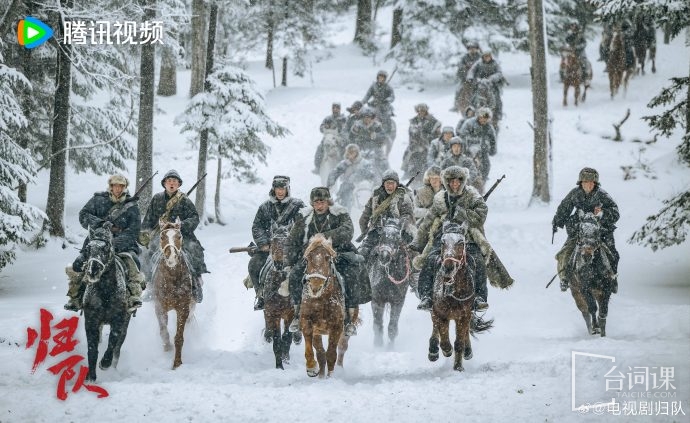
When the Japanese army heard the news, Lu Changshan rushed over. At the order, they fought fiercely with the Japanese army. The big donkey rode on his horse and ran away, and the other horses followed him out.When Lu Changshan saw that all the horses were transferred, he blew up the Japanese trucks and then returned with his soldiers on horseback.